Hardware abstraction standardisation
One HAL architecture across your entire product portfolio
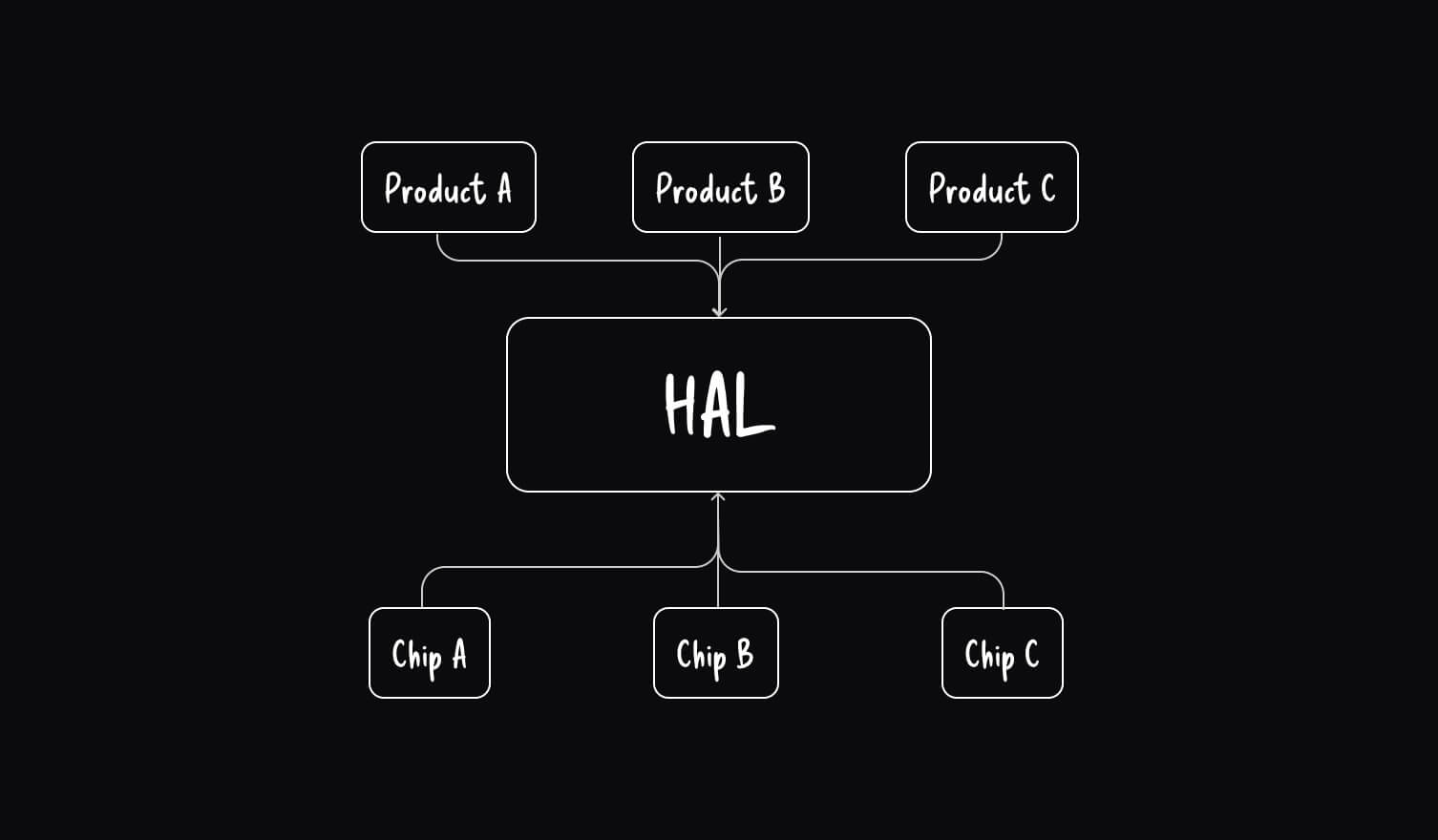
When every product has its own driver architecture, every integration is a one-off. Embedd generates drivers from a common methodology — giving you consistent APIs, consistent patterns, and consistent quality across every product.
The Problem
Over time, different products, different teams, and different vendor SDKs produce a patchwork of driver architectures. Every product has its own conventions for error handling, its own interrupt patterns, its own naming schemes. Cross-product reuse is theoretical. Test suites don't transfer. New engineers spend weeks learning each product's quirks. The lack of standardisation is invisible in any single project but costs heavily across the portfolio.
This is compounded by vendor-supplied BSPs. Each silicon vendor delivers drivers in their own architecture, with their own conventions. An NXP BSP looks nothing like a Cypress BSP. When your product portfolio spans multiple vendors — which it almost certainly does — your team is maintaining fundamentally different codebases for what is functionally the same layer of software.
How Embedd Solves It
Embedd generates all drivers from the same methodology — same architecture, same API patterns, same error handling, same naming conventions — regardless of the underlying hardware. Whether the driver is for an NXP MCU or a Cypress part, whether the target is bare metal or Zephyr, the generated output follows consistent patterns. Standardisation is a property of the generation process, not a policy you have to enforce.
What You Get
Consistent driver API surface across all products in your portfolio
Test suites that transfer between products — write once, apply across the fleet
Faster onboarding for engineers moving between product lines
Reduced integration effort when components or subsystems are shared across products
Standardisation that maintains itself — every regeneration follows the same patterns
Who This Is For
Engineering organisations managing multiple product lines who need cross-product consistency. Teams where driver quality and architecture varies too much between products.